The screen changed. Human nature didn’t. A hard-hitting essay on media, manipulation, and the audience that never learned to question.
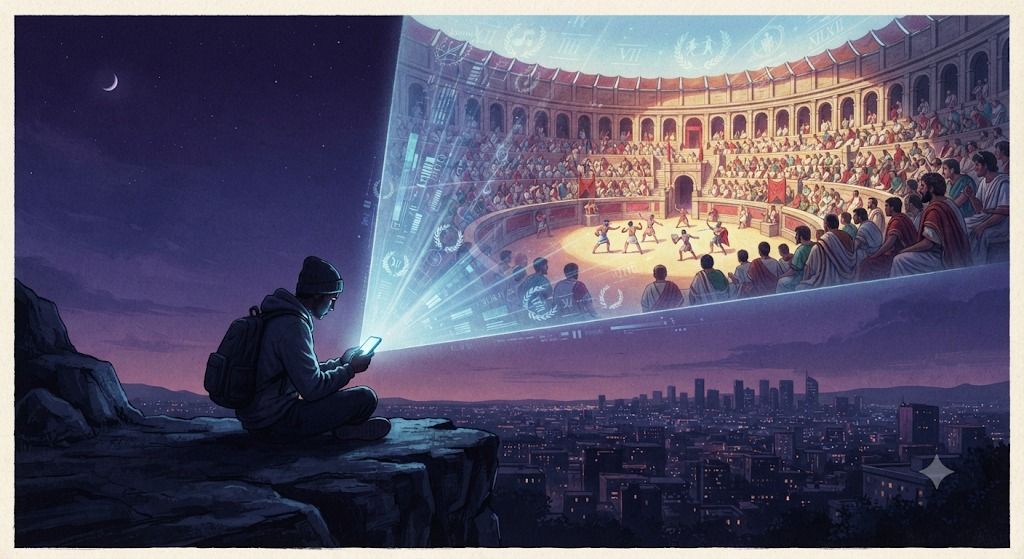
Every generation believes it is more enlightened than the one before it. But has human nature really changed?
Every generation looks at the one after it and concludes that something has gone wrong.
The old complain about the young. The young complain about the old. Everyone agrees the world is getting worse, and everyone is certain they are the last sane generation standing.
They point at screens. At scrolling. At attention spans. At the collapse of everything they grew up with.
And they are wrong.
Not about the screens. About the assumption that anything fundamental has changed.
Every Generation Has Had Its Own Screen
Today, people sit in front of screens watching videos, debates, news and entertainment. A few decades ago, they sat in front of television sets. Before television, they gathered around radios. Before radio, they gathered to listen to storytellers, preachers, public speakers and travelling performers.
And long before all of that, kings organised grand spectacles, public celebrations, competitions and even fights for the entertainment of their subjects.
Different periods. Different arrangements. Different technologies.
But the audience was always there.
A king once staged a spectacle to keep his subjects entertained. A preacher once shaped the beliefs of a gathering. A broadcaster once decided what millions would hear. A network once decided what millions would watch.
Now an algorithm decides what you see before you have decided what to look for.
Different stage. Same play.
The crowd still gathers. The crowd still cheers. The crowd still argues about what it was shown, not who decided to show it.
And the crowd still believes it chose to be there.
The Entertainment Never Changed. Only the Stage Did.
Imagine a king organising a grand spectacle for his people.
The crowd gathers. Everyone watches. Some cheer, some argue, some get emotionally involved, and others simply enjoy the excitement.
Now replace that royal spectacle with a television debate. Replace the public gathering with a social media platform. Replace the royal announcer with a news anchor, an influencer or a digital content creator.
The setting changes, but the basic human response remains remarkably familiar.
People want to be entertained. They want to belong to something. They want to hear stories that excite them, opinions that reassure them and narratives that give them someone to admire or someone to oppose.
The medium has become faster, cheaper and more accessible.
The instincts that draw us towards it are much older.
Perhaps that is why every generation complains about the generation that follows it. The older generation criticises youngsters for spending hours on mobile phones. The generation before them complained about television. Earlier generations had their own concerns about the influences surrounding young people.
Everyone is convinced the present generation is going in the wrong direction. Rarely does anyone ask whether the previous generations were fundamentally different — or simply occupied by different things.
Someone Is Always Choosing What You See
An audience does not always decide what it gets to watch. Someone decides what is presented, what receives attention, what is repeated and what is left out.
A king could organise a spectacle. A preacher could shape the beliefs of a gathering. A broadcaster could decide what reached millions of listeners. Television networks could influence public conversations.
Today, digital platforms, content creators, media organisations and political communicators operate in an environment where information can reach millions within seconds.
The tools are different. The influence of the storyteller remains.
Consider how easily a particular subject can dominate public attention. One event becomes the headline of the day. One opinion becomes the subject of endless debate. One person becomes a hero, another becomes a villain. A particular narrative gets repeated until it begins to feel familiar — and familiarity is easily mistaken for truth.
What you see is not the entire picture.
It is the picture that reached you.
Every medium is a filter. Every filter is a choice. Every choice is made by someone.
The question is never simply “is this true?” The question is “who decided this is what I get to see?”
You are not watching the world. You are watching a selection of the world, arranged by someone whose interests may or may not align with yours.
That is not paranoia. That is the basic mechanics of every screen you have ever looked at.
The person controlling the stage may change. The power to influence the audience remains.
The Flock Does Not Know It Is Being Led
A flock moves because something moves it.
The sheep do not decide where the flock goes. They follow the sheep in front of them, who are following the sheep in front of them, who are following a direction set by someone the flock will never meet.
You can call it society. You can call it culture. You can call it the marketplace of ideas. The vocabulary is polite. The mechanism is the same.
The wolves are not always evil. Some of them believe they are shepherds. Some of them are. But whether the hand is cruel or kind, the flock is still being led.
The uncomfortable question is not whether this happens. It obviously does.
The uncomfortable question is: how often are you the one being led without knowing it?
How often do we examine the direction in which we are being moved?
We follow a trend because everyone is following it. We accept an opinion because someone influential expressed it. We develop strong reactions to events we barely understand. We defend positions without examining the arguments behind them.
Sometimes we do not even realise that an opinion we consider our own has been repeatedly presented to us by someone else.
And this is not a problem exclusive to the internet. A person who blindly accepted everything heard on the radio was not more independent than someone who blindly accepts everything seen on a mobile phone.
The technology does not make the audience intelligent or ignorant. The difference lies in whether the person is willing to question what is being presented.
An unthinking audience is easy to influence, regardless of the century it belongs to.
You Are Not as Awake as You Think
We have access to more information than any previous generation. We can read different perspectives, examine historical events, compare arguments and communicate with people across the world.
Yet access to information and the ability to think independently are two different things.
We assume that because we know more about the world, we understand it better.
But knowing about an event is not the same as understanding it. Hearing an argument is not the same as examining it. Repeating an opinion is not the same as forming one.
We can consume thousands of pieces of information and still remain unaware of how our own thinking is being shaped.
In fact, the abundance of information makes it easier to remain inside our preferred narratives. We find people who agree with us, content that reinforces our beliefs and arguments that make us feel right.
We are exposed to more voices, but we do not necessarily listen to more perspectives. We have expanded our sources of information. Have we expanded our willingness to question ourselves?
The real illusion of modernity is the belief that technological progress automatically produces intellectual progress.
It does not.
The Screen Changed. You Did Not.
The world has changed enormously. Communication, education, governance, technology and access to knowledge have transformed human life in ways our ancestors could hardly have imagined.
But beneath these changes, certain human tendencies remain familiar.
The desire to be entertained. The need to belong. The attraction towards power. The comfort of following a familiar voice. The temptation to believe what confirms our existing opinions. And the willingness to let someone else do the thinking when independent thought becomes inconvenient.
These tendencies have appeared in different forms throughout history.
The younger generation is not the first to be influenced by its surroundings. It is simply the first to experience those influences through a device that fits into its pocket and follows it everywhere.
The screen is closer. The reach is greater. The speed is unprecedented.
But the human mind receiving the information is still human.
The Final Thought
Every generation looks at the next one and wonders what has gone wrong.
The older generation remembers people gathering around radios. The next remembers families watching television together. The present generation watches individuals carrying entire entertainment industries in their pockets.
We laugh at the habits of those who came before us and worry about the habits of those who come after us.
Yet we should pause before declaring ourselves different.
Kings had their spectacles. Preachers had their gatherings. Broadcasters had their listeners. Television had its viewers. The internet has its users.
Every age has had its storytellers, its audiences and those who understood how to capture public attention.
The tools have evolved. The reach has expanded. The performance has become more sophisticated.
But the relationship between the storyteller and the audience is still very much alive.
Your ancestors had their spectacles. Their preachers. Their radio voices. Their television anchors.
You have your feed.
The screen changed. The audience did not. The wolves did not. The flock did not.
We should not mistake a new screen for a new human being. We should not mistake access to information for independence of thought. And we should certainly not assume that living in a technologically advanced age makes us immune to the influences that shaped every generation before us.
The only question that matters is whether you are watching the show — or whether the show is watching you.
Because one of those is entertainment.
The other is a business model. And you are the product.


Leave a Reply