Explore the hidden struggle of the modern sandwich generation. Learn how Millennials navigate the gap between previous generations’ rules and Gen Z’s authentic “no hindrance” lifestyle.
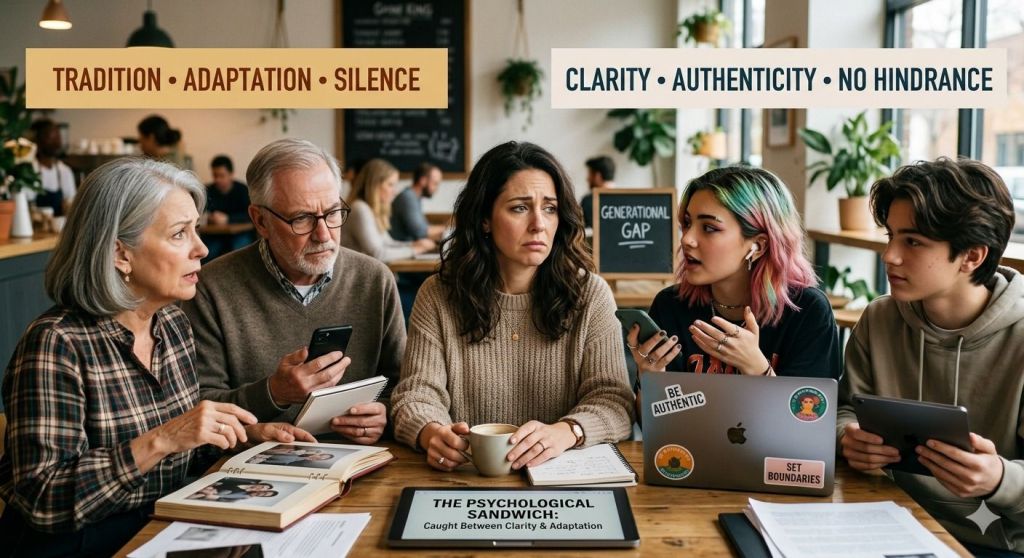
Have you ever sat at a family dinner, listening to your parents reminisce about “hard work” and “sacrifice,” while your teenager (or Gen Z colleague) casually mentions that they are “setting boundaries” or “quiet quitting“?
If you’re a Millennial, you might have felt a familiar knot in your stomach. You understand exactly where your parents are coming from—their entire world was built on the premise that survival required adaptation, silence, and resilience. But you also look at the absolute clarity and “no hindrance” attitude of Gen Z and think, Wow, I wish I could do that.
This is the new reality for a massive segment of the population. We are not just the “sandwich generation” who are financially caring for both children and aging parents. We are the Psychological Sandwich. We are the group stuck in an emotional and behavioral middle ground, caught between the rigid traditionalism of our parents and the radical, unapologetic authenticity of the kids coming up behind us.
And the hardest part? We’re often the ones getting mocked by both sides for the crime of trying to bridge the gap.
The Art of Adaptation (and Its Hidden Cost)
To understand this conflict, we first have to understand the foundational programming of older generations. Their worldview was shaped by a different set of economic and social realities. Stability was the ultimate goal, and that stability was often won through conformity and silence.
For them, “adaptation” wasn’t a choice; it was a survival mechanism.
They learned to follow the rules, keep their heads down, and not rock the boat. They “put in their time,” even in roles that crushed their spirits, because they were taught that loyalty would eventually be rewarded. Emotion was for private moments, and vulnerability was a weakness, especially in professional settings. This created a generation that is incredibly resilient, yet sometimes deeply repressed.
For previous generations, the clarity of wanting something wasn’t enough. They believed they had to endure a great deal of “hindrance” to earn the right to exist in the world. Their identity was formed not by what they wanted, but by how well they adapted to the world as it was handed to whom.
The Gen Z Revolution: Radical Clarity and the End of Hindrance
Then came Gen Z. Raised with the internet as a native tongue and global interconnectedness as a birthright, their worldview is radically different. They didn’t grow up believing that the systems around them were infallible. They’ve seen global financial crashes, a pandemic that upended the working world overnight, and an environmental crisis that feels urgent and existential.
This unique set of circumstances has bred a generation that is, to its core, radically authentic.
When Gen Z look at the world, they don’t see unchangeable rules. They see outdated scripts. They possess a clarity that previous generations find startling, and sometimes offensive. If a job is toxic, they quit. If a social interaction is draining, they establish a boundary. If they have an opinion, they share it—publicly, on a platform with global reach.
They have very little patience for what they perceive as “hindrance.” This isn’t about laziness or entitlement, though it is often mischaracterized that way. It’s about a fundamental belief that people should not be forced to endure suffering, repression, or inauthenticity in the service of an outdated ideal of stability. Their “acceptance” isn’t passive; it’s an active embracing of diverse identities, perspectives, and ways of being that previous generations fought to suppress.
The Middle Child: Stuck in the Psychological Sandwich
And then there are the Millennials. The “middle children” of history, as some call them. We are uniquely positioned to be the translation layer, and that’s a heavy burden to carry.
We remember life before the internet, but we also built the modern social media landscape. We entered the workforce during the worst economic recession in a century (the late 2000s), only to be told we were lazy for not achieving the same milestones as our parents. We are the generation that normalized the “side hustle” and the “passion project,” desperately trying to find meaning in a world where the old paths to success were crumbling.
Our adaptation was different. We were the last generation raised on the old rules (“go to college, get a job, buy a house”) who then had to pivot and learn a completely new set of skills mid-game. We learned to “code-switch,” adapting our behavior to appease traditional bosses while navigating a rapidly changing digital economy. We are polite, we say “yes” too much, and we are often crippled by anxiety over how we are being perceived.
We understand our parents’ need for conformist stability because we saw them build it. But we also deeply empathize with Gen Z’s demand for authenticity because we’ve felt the pain of repressing ourselves for decades.
Mocked from Both Sides: The Price of Being the Bridge
This is where the real ache of the psychological sandwich is felt. We are the only generation that truly sees both sides, yet neither side respects our perspective.
To our parents, we are often seen as overly sensitive or too emotional. They might mock us for our focus on “mental health” or “self-care,” phrases that were alien to them. They see our complex internal worlds as evidence of a lack of true, gritty resilience. To them, we are “snowflakes” for even feeling the friction that they learned to ignore.
But to Gen Z, we are the villains. We are the original “cringe.” They look at our carefully curated social media feeds, our tendency toward self-deprecation, and our reluctance to make a direct, uncomfortable demand, and they see it as “performative” and “inauthentic.” To them, we are too scared, too anxious, and too tied to old systems. They mock us for being stuck in the “hindrance” that they have so effortlessly discarded.
We are, as the user perfectly put it, the generation that is getting mocked by both parents and kids. Our superpower—the ability to adapt and understand—is viewed as a weakness by both ends of the age spectrum.
Beyond the Sandwich: The Importance of the Translation Layer
So where does this leave us? Is the middle generation doomed to live a life of eternal misunderstanding?
Not necessarily. In fact, our unique position as the “Translation Generation” may be our greatest, albeit most challenging, purpose. The world is changing faster than ever before. For society to progress without fracturing, we need people who can speak both languages.
We are the ones who can explain the value of deep, patient endurance to Gen Z when their radical clarity leads to burnout. We are the ones who can help our parents understand that a demand for mental health is not a sign of weakness, but a path to a more sustainable form of strength.
The isolation of being the psychological sandwich is real. It’s hard to be the emotional translator for a world that seems content to just keep shouting past each other. But by leaning into our layered identity—by validating our own unique form of adaptation while also championing the clarity of the future—we might find our own authentic voice, and in doing so, help others find theirs.
 Anu-Chintanam
Leave a comment