The following shloka of Bhagavad Gita delves into the nature of experiences and emotions arising from subjective associations. It highlights the impermanent nature of these experiences, drawing analogies from the transience of cold and heat. The shloka also emphasizes the role of self-love and affection in shaping our responses to material relations and suggests the path to alleviate suffering through detachment. Let us explore this profound verse that unravels the essence of happiness and sorrow in the realm of subjective connections.
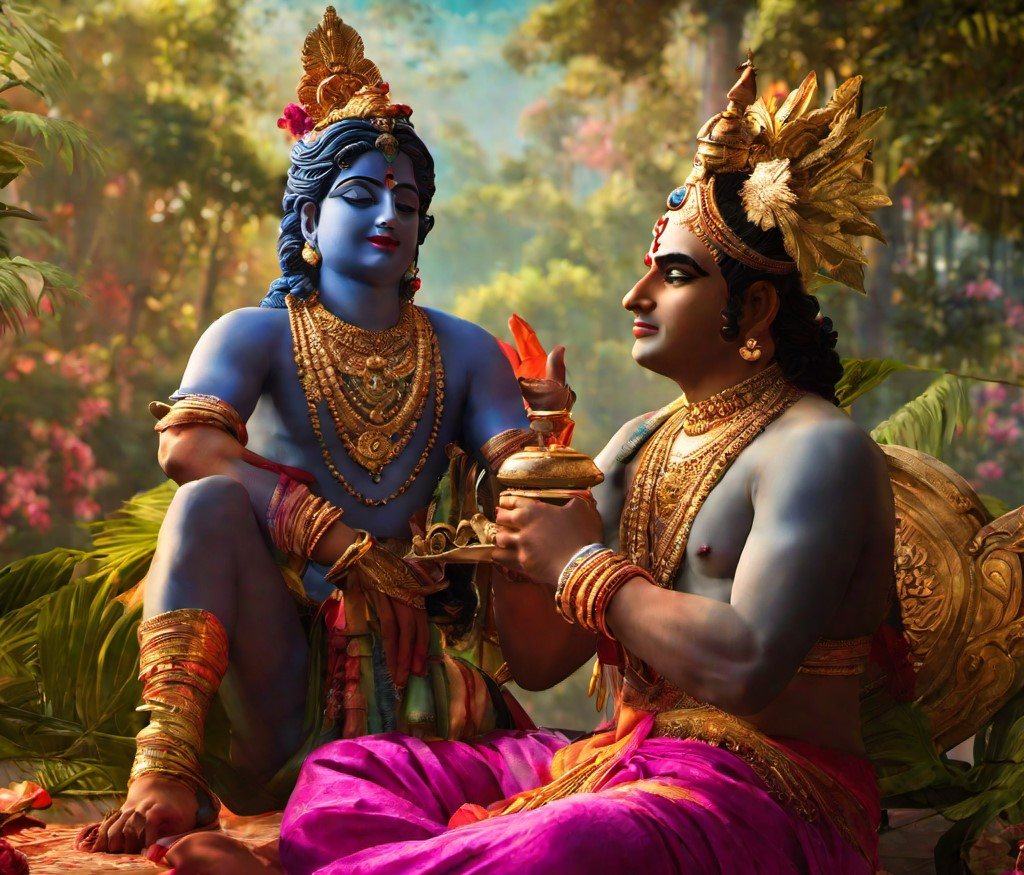
Arjuna raises a question to Krishna, acknowledging that the soul is imperishable and that a new body will follow after the current one is destroyed. Therefore, he understands that there should be no sorrow for the suffering of his relatives. However, he admits that even though Krishna’s teachings make sense, he will still feel sadness if they were to die. Arjuna finds joy in their presence and the emotional connections with their physical forms, so losing them would deprive him of that happiness. Additionally, he is troubled by the thought of having to witness their disfigured bodies in the battle, wounded by his own weapons, which would bring him immense grief. In response to Arjuna’s concerns, Krishna imparts wisdom through the following verse.
मात्रास्पर्शास्तु कौन्तेय शीतोष्णसुखदुःखदाः।
आगमापायिनोऽनित्याः तांस्तिक्षस्व भारत ॥२-१४॥
Furthermore, Krishna points out that our emotions towards things arise from illusory attractions and aversions. We develop desires for things we consider good, and hatred towards those we perceive as unfavorable. Moreover, excessive attachment to the body-mind complex leads to a sense of oneness or separateness, which also influences our experiences of happiness and suffering.
Krishna offers an example of how the same event can lead to different emotions in different people based on their attachments and perspectives. Thus, the underlying cause of happiness and sorrow is selfishness or self-centeredness.
Consider this example: In a road accident, when a person is injured, those who have a strong attachment, considering the injured person as “theirs,” feel sorrow. On the other hand, those who hold negative feelings towards the injured person, feeling a sense of detachment, may find happiness in the misfortune. Hence, when two individuals witness the same event, their emotional reactions can be entirely opposite. Thus, it becomes evident that the root of happiness and sorrow lies in selfishness or self-centered perspectives.
शीतोष्णसुखदुःखदाः (Sheetoshnasukhadukhadah) – Additionally, Krishna explains that sensations like feeling cold in winter or enjoying a cool breeze in summer are experienced as long as we are conscious of our body. However, during deep sleep when there is no awareness of the body, happiness and sorrow cease to exist. Therefore, the root of these experiences lies in our attachment to the physical body.
In essence, Krishna’s teachings emphasize that true contentment and liberation come from transcending selfish desires and attachments, leading to a state beyond happiness and sorrow, which can be realized by understanding the illusory nature of the body-mind connections.
आगमापायिनः (agamapayinah) – The reason why material relationships cause happiness and suffering through sensory experiences is due to our attachments and selfish perspectives. These relationships are based on temporary and fleeting connections, as indicated by the term “agamapayinah,” which implies that happiness and unhappiness in such relationships are not permanent but fluctuate over time.
Let’s consider the analogy of feeling the contact of cold sandalwood or hot sparks from fire on our skin while sleeping or fainting. During sleep, the mind remains connected to the body’s senses, but there is a lack of consciousness or self-awareness. Consequently, there is no perception of heat or cold, happiness, or sorrow during this state of rest. However, upon waking up, the sense of self-awareness returns, and subsequently, happiness and sorrow resurface.
From this, it becomes evident that the experiences of happiness and unhappiness are intricately tied to our subjective connections with the external world. When there is self-awareness, the mind perceives happiness or sorrow based on sensory experiences, but when that awareness is absent, such feelings do not manifest.
In summary, material relationships lead to happiness and unhappiness through sensory experiences due to our attachments and the presence or absence of self-awareness, highlighting the impermanent nature of such emotions.
To attain Jnana (knowledge or wisdom), the soul must align with the mind, and the mind must harmonize with the senses. The senses, in turn, must be in sync with the external world. However, during sleep, certain senses like the eyes and tongue are disconnected, and even though the ears are still receptive to sound and the nose to smell, the mind remains absorbed in the body’s internal processes, specifically the pulse.
Nonetheless, the sense of touch (Tvagindriya) pervades the entire body, necessitating a connection between the mind and the external world. Despite this connection, true knowledge does not arise spontaneously. To attain knowledge, one needs to rely on Abhimana (self-awareness or a sense of “I”ness). The Gita uses terms like “cold” and “hot” to illustrate this point, emphasizing the need to understand the subject without dwelling on other external distractions.
‘Agama+Apai’ signifies the cyclic nature of certain objects, either appearing for a period and then disappearing, like the blooming of the pearl flower or continuously flowing but with individual water particles differing momentarily, as seen in the Ganges river. In the context of subjective relationships, these experiences of happiness and sorrow are termed ‘Agamapai.’ The question arises whether such experiences are like the pearl flower or the water drop in the Ganges.
The answer is that these experiences resemble the pearl flower but not the continuous flow of the Ganges. During dreamless sleep or unconsciousness, like in asamprajnatasamadhi, pleasure and pain do not arise due to subjective associations. Therefore, the experiences are intermittent, akin to the blooming and fading of the pearl flower. There is no permanence in the flow of happiness and sorrow as found in the constant Ganges river.
The reason for this intermittence is that affection plays a vital role in triggering happiness and sorrow through subjective relationships. Only when there is attachment or fondness do material relations bring joy. Without self-love or self-centeredness, these relationships do not induce happiness or sorrow.
अनित्याः ‘Anityah’ – refers to the transient nature of experiences like cold and heat. The subjective associations that give rise to such experiences and consequently happiness and sorrow are, in fact, impermanent.
तान् तितिक्षस्व ‘Taan Titikshasva’ – conveys the idea that when one lacks self-love or self-centeredness, material relations cease to be a source of happiness or sorrow. Therefore, one should relinquish these two types of attachment and render material relations inconsequential. By doing so, they can minimize the suffering caused by these attachments. Without affection, material relations lose their power to evoke happiness and unhappiness since they are merely components contributing to the material fabric of joy and sorrow. It is akin to attempting a task that requires multiple components while only possessing one.
In essence, these teachings suggest that the experiences of happiness and sorrow, driven by subjective associations, are impermanent. By detaching oneself from self-centered love and material attachments, one can avoid unnecessary suffering and find a sense of equanimity.
Thus, Krishna advises Arjuna to relinquish both types of love – attachment and aversion – to minimize suffering in material relationships. The absence of affection prevents these relationships from causing emotional ups and downs, as they are merely one element contributing to the material of happiness and sorrow.
To sum up, Krishna resolves Arjuna’s confusion by explaining the nature of subjective relationships, their cyclic and intermittent aspects, and the role of affection in experiencing happiness and sorrow. He encourages Arjuna to transcend these attachments to find inner peace and contentment.
 Anu-Chintanam
Leave a comment